
You’ve checked the door lock four times. You know it’s locked. You saw it, you felt it, and you even took a picture. But a few minutes later, that nagging voice comes back: What if it isn’t?
If that sounds familiar, you already know OCD isn’t about being neat or a little picky. It’s exhausting. It eats up hours, steals your focus, and makes you feel trapped by your own thoughts.
The good news is that OCD is treatable, and several evidence-based treatments can significantly reduce symptoms. The two treatments with the strongest evidence behind them are a special kind of therapy called exposure and response prevention (ERP) and certain medications. Many people get the best results using both together.
Harmony United Psychiatric Care is a premier mental health clinic serving communities across Florida.
Find a provider near you
Why OCD needs the right kind of help
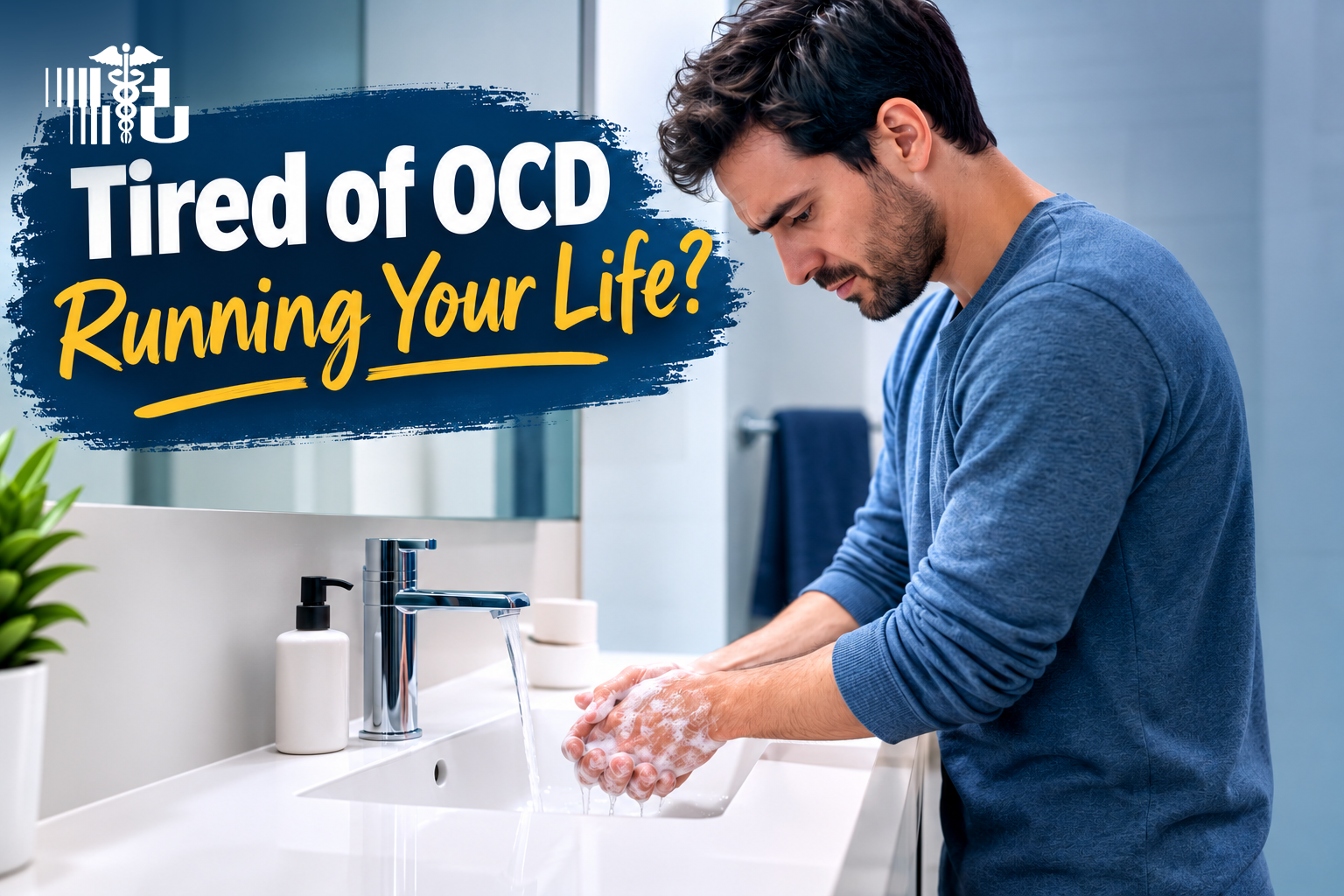
OCD works like a trap. A scary thought pops into your head, like “What if my hands have germs?” That thought brings a wave of anxiety. To make the anxiety go away, you do something, like washing your hands. You feel better for a little while.
The problem is that your brain remembers that relief. So next time, the urge to wash comes back even stronger. The more you give in, the louder OCD gets.
This is why regular talk therapy doesn’t always help. If a therapist or family member keeps telling you, “Don’t worry, everything’s fine,” it feels good in the moment. But that reassurance becomes just another way of calming the fear, and the cycle keeps spinning.
Effective OCD treatments don’t simply make the fear go away. It helps you learn that you can experience uncertainty and anxiety without relying on compulsions to feel safe.
Intrusive thoughts aren’t the problem by themselves
Most people have unwanted or unusual thoughts from time to time. In OCD, the problem is often the meaning a person gives to those thoughts and the compulsions they use to reduce the distress they cause.
Having an intrusive thought does not mean you want it, believe it, or will act on it. The thought may feel disturbing precisely because it goes against your values or what matters to you.
OCD can make these thoughts feel urgent or meaningful, leading you to seek reassurance, check, avoid certain situations, or perform rituals to feel certain or safe. Treatment focuses on breaking that cycle rather than trying to eliminate every unwanted thought.
First line of OCD treatments
OCD can be treated in several ways. Most people start with therapy, medication, or both.
- Exposure and Response Prevention (ERP): One of the most strongly supported psychological treatments for OCD. You slowly face your fears in small, planned steps and practice not doing the rituals that usually follow. Over time, your brain learns that the anxiety will pass on its own.
- Medication (SSRIs): Antidepressants like fluoxetine and sertraline can ease obsessions. Many people need two to three months to feel the full effect. It can take several weeks and sometimes longer to see the full benefit.
- Clomipramine: An older medication approved for OCD, sometimes used when SSRIs don’t help enough.
Other approaches that may be used
- Cognitive Behavioral Therapy (CBT): Helps you spot and change unhelpful thought patterns. For OCD, it works best when it includes ERP.
- Acceptance and Commitment Therapy (ACT): Instead of trying to push intrusive thoughts away, ACT teaches you to let them be there without acting on them. Often used alongside ERP.
- Transcranial magnetic stimulation: TMS is an FDA-approved, medication-free option that uses gentle magnetic pulses to target brain areas linked to OCD.
- Intensive treatment programs: Daily ERP sessions for people with severe OCD who need more support than weekly therapy.
- Family support: Helps loved ones support recovery without feeding the reassurance cycle.
A psychiatric provider can help you find the right mix for your needs.
What effective OCD treatments actually look like
OCD treatments aren’t about making every intrusive thought disappear or finding a way to feel completely certain. The goal is to change how you respond to the thoughts, fears, and urges that keep the OCD cycle going.
Effective treatment focuses on:
- Facing fears gradually: Working through triggers instead of continually avoiding them.
- Reducing compulsions: Learning to resist checking, washing, reassurance-seeking, or other rituals.
- Tolerating uncertainty: Accepting that you may not always have 100% certainty or reassurance.
- Practicing between sessions: Applying what you learn in therapy to everyday situations.
- Building long-term skills: Learning how to respond differently when intrusive thoughts return.
It isn’t about:
- Trying to control every thought that enters your mind.
- Getting repeated reassurance that everything is okay.
- Avoiding anything that makes you anxious.
- Waiting until you feel completely comfortable before moving forward.
The goal isn’t to make anxiety disappear before you live your life. It’s to help you stop letting OCD decide what you can do.

What is ERP therapy for OCD?
Exposure and Response Prevention (ERP) is a specialized form of cognitive behavioral therapy (CBT) designed to treat OCD. It’s considered the best therapy for the condition, and it has two simple parts:
- Exposure: Slowly and safely facing the things that trigger your fear
- Response prevention: Choosing not to do the ritual you’d usually do afterward
At first, that sounds scary. But something powerful happens. When you sit with the anxiety instead of fighting it, it rises, peaks, and then fades on its own. Your brain starts to learn, “I can handle this without the ritual.”
With practice, ERP helps you learn to tolerate distress and uncertainty without relying on compulsions. Over time, the situations that trigger OCD symptoms may become easier to manage.
What ERP looks like in real life
Picture someone who washes their hands 30 times a day because they’re afraid of germs. Their therapist won’t throw them into the deep end. Instead, they build a step-by-step plan together, starting small:
- Touch a doorknob, then wait 5 minutes before washing.
- Touch a doorknob and wait 30 minutes.
- Touch a grocery cart and eat a snack without washing.
- Use a public restroom and wash only once, quickly.
ERP treatment typically involves regular sessions and practicing skills between appointments. The length of treatment varies depending on symptom severity, individual progress, and the treatment approach.
Medication for OCD
Medication can turn down the volume on scary thoughts and urges. That often makes it easier to do the hard work of therapy.
What medication is used for OCD?
The Selective serotonin reuptake inhibitors (SSRIs) are medications that affect serotonin signaling in the brain and can help reduce OCD symptoms. These are antidepressants that help balance serotonin, a brain chemical tied to mood and anxiety. SSRIs approved by the FDA for OCD include fluoxetine (Prozac), fluvoxamine, sertraline (Zoloft), and paroxetine (Paxil). An older medication called Clomipramine, a tricyclic antidepressant, is also FDA-approved for OCD and may be considered when SSRIs aren’t effective or well tolerated.
Here’s what makes OCD medication a little different:
- It takes time. SSRIs may take several weeks to begin improving OCD symptoms, and the full benefit may take 8–12 weeks or longer.
- Doses are often adjusted. Your provider may raise or change your dose to find what works best.
- It works better with therapy. For some people, combining medication with ERP provides additional symptom relief, particularly when OCD symptoms are moderate to severe.
If the first medication doesn’t help, don’t lose hope. Trying a different one is a normal part of the process.
Can OCD be treated without medication?
Yes. ERP can be effective on its own, while medication may be recommended based on symptom severity, treatment history, co-occurring conditions, patient preference, or access to specialized therapy.
There’s no one right answer. The best plan is the one that fits your symptoms, your history, and what you’re comfortable with.
What if nothing has worked so far?
Some people try therapy and a few medications and still feel stuck. Intensive programs that offer ERP several days a week can also help when weekly sessions aren’t enough. Transcranial magnetic stimulation (TMS) is FDA-cleared for OCD. It uses gentle magnetic pulses to target the parts of the brain linked to OCD, with no surgery and no downtime (something like) and may be considered when other treatments haven’t provided sufficient relief.
Signs your treatment needs a change
Treatment should move you forward, even if it’s slow. It may be time to talk with your provider if:
- You’re still relying heavily on compulsions or reassurance despite treatment.
- You’ve given a medication an adequate trial but haven’t noticed meaningful improvement.
- Your rituals are taking up more time, not less.
- You’re feeling more hopeless or worn down.
Finding the right support
If you’re searching for a psychiatrist near me for OCD, look for a provider who regularly treats OCD and understands how ERP and medication can work together. Don’t be afraid to ask questions like, “How do you usually treat OCD?” or “What happens if the first medication doesn’t work?” If getting to an office is hard, ask whether they offer virtual visits.
Harmony United Psychiatric Care offers comprehensive psychiatric evaluations and personalized medication management for OCD across Florida. For eligible patients, TMS therapy may also be available at select locations. Our team can help you explore treatment options based on your symptoms, history, and individual needs. In-person and telepsychiatry appointments are available, depending on the service and provider.
To schedule an appointment, call 800-457-4573 or submit an appointment request and take that first confident step toward feeling like yourself again.
Final Thoughts
OCD can make you feel like you’re constantly negotiating with your own thoughts. But intrusive thoughts and compulsions don’t have to control your day. Evidence-based treatments such as ERP and medication can help reduce symptoms and break the cycle.
Finding the right treatment may take some adjustment, but struggling with OCD doesn’t mean you’re beyond help. With the right support and a treatment plan tailored to you, meaningful improvement is possible.
Frequently Asked Questions
Exposure and Response Prevention (ERP) is one of the most strongly supported psychological treatments for OCD. ERP helps you gradually face feared situations while learning to resist the compulsions that usually follow. Medication, particularly SSRIs, may also be used alone or alongside ERP depending on your symptoms, treatment history, and preferences.
Yes. ERP can be an effective treatment on its own, particularly when a person can participate in specialized OCD therapy. Medication may be recommended based on symptom severity, previous treatment, co-occurring conditions, or individual preference. A psychiatric provider can help determine which approach makes sense for you.
ERP is not a quick fix, and the timeline varies from person to person. Many people attend weekly sessions for several months while practicing ERP skills between appointments. Some people begin noticing improvements within a few weeks, but meaningful progress often requires consistent practice over time.
OCD medications such as SSRIs can take several weeks to begin improving symptoms, and it may take longer to see their full benefit. Your provider may adjust the dose or consider a different medication depending on how you respond. Medication should be taken and adjusted under the guidance of a qualified healthcare professional.
If your symptoms aren’t improving, talk with your provider before stopping treatment or medication on your own. Your treatment may need to be adjusted, or you may benefit from a different approach, such as specialized ERP, a medication change, or a more intensive treatment program. Persistent symptoms do not mean that effective treatment is out of reach.
OCD is a chronic condition for many people, but treatment can significantly reduce symptoms and help you regain control over your daily life. The goal of treatment is not necessarily to eliminate every intrusive thought. Instead, it is to help you respond differently to unwanted thoughts and urges so they no longer control your decisions, routines, or time.
Reference Links
https://pmc.ncbi.nlm.nih.gov/articles/PMC10591165
https://www.nhs.uk/mental-health/conditions/obsessive-compulsive-disorder-ocd/treatment
Leave a Reply