
Trusted Neuropsychological Testing for Cognitive Understanding
When memory, attention, language, or problem-solving begin to feel different, it can be difficult to understand what is causing the change. Neuropsychological testing offers a closer look at how different thinking skills are working so providers can better understand symptoms and recommend the right next steps.
At Harmony United Psychiatric Care, neuropsychological testing is used to understand better how cognitive strengths and weaknesses may be affecting daily life, school performance, work responsibilities, or overall functioning. It can be especially helpful when concerns are complex, when symptoms overlap, or when more information is needed to guide diagnosis and treatment planning.
Unlike EEG testing or brain imaging such as CT or MRI scans, neuropsychological testing focuses on how the brain is working through performance-based tasks. It does not look at structure alone. Instead, it measures how different mental abilities function in real-life use, which is often important when other evaluations do not fully explain symptoms. appraisals, report cards, transcripts), a clinical interview with the client (and family member, if applicable), a few hours of neuropsychological testing using standardized measures of cognition, production of a written report, and a feedback session for the client and family.
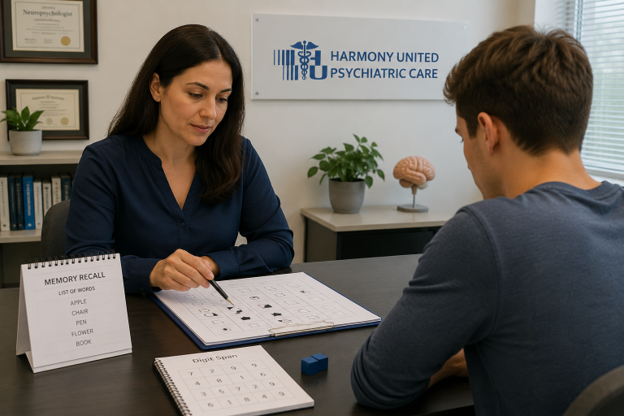
What Neuropsychological Testing Evaluates
Neuropsychological testing looks at a broad range of cognitive and emotional abilities to help paint a full picture of functioning. The assessment may measure attention, concentration, memory, reasoning, language, learning, processing speed, executive functioning, visual-spatial skills, motor coordination, and social-emotional functioning.
These areas are important because they influence how a person performs in school, at work, at home, and in social settings. Even when someone appears to be doing well in one area, subtle difficulties in another may be affecting daily functioning in ways that are not immediately obvious.
In children and adolescents, the evaluation is often interpreted within a developmental framework. That means performance is compared not only to age- or grade-level peers, but also to the individual’s own developmental history and patterns of strengths and weaknesses.
This broader view can be especially useful when symptoms affect learning, behavior, attention, or emotional regulation. It helps providers understand not only what is happening, but also why it may be happening.
When Neuropsychological Testing is Recommended
A neuropsychological evaluation may be recommended when a person is having ongoing concerns that are difficult to fully explain through a standard clinical visit. It is often used when there are questions about
- Learning disorders and learning differences.
- Inattentiveness, hyperactivity, or impulsivity.
- Weak executive functioning, such as trouble planning or organizing.
- Processing-speed difficulties.
- Language disorders or language delays.
- Visual-spatial, visual-motor, or fine motor concerns.
- Intellectual disability.
- Autism spectrum disorder.
- Anxiety.
- Depressed mood.
- Behavioral difficulties at home or in school.
- Cognitive or learning problems related to neurological or birth conditions.
- Giftedness combined with learning or emotional challenges.
- seizure disorders
- Epilepsy
- Traumatic brain injury
- Brain tumor
- Hydrocephalus
- Complications related to premature birth
In these situations, testing can help identify how the condition may be affecting cognition, learning, and day-to-day functioning.
For children, school-age patients, adolescents, and young adults, the evaluation can be especially helpful when difficulties show up differently across home, school, and social settings. It may reveal patterns that support educational planning, family understanding, and more effective treatment recommendations.
How the Evaluation Works
At Harmony United Psychiatric Care, a neuropsychological assessment is a structured process that usually begins with a review of relevant background information. This includes medical records, previous assessments, school records, report cards, transcripts, work appraisals, or other documents that can help provide context for the concerns being evaluated.
The process also includes a clinical interview with the patient. In some cases, a family member or caregiver may be involved as well, especially when the evaluation is being completed for a child or adolescent. This interview helps the clinician understand the history of symptoms, current concerns, and the situations in which difficulties are most noticeable.
After the interview, the patient completes several hours of standardized neuropsychological testing. These tasks are designed to measure different areas of cognition in a consistent and reliable way. The testing may involve questions, problem-solving exercises, memory tasks, language activities, and other activities that help evaluate how the brain is functioning.
Once testing is complete, the results are analyzed and organized into a written report. The report explains the findings clearly and places them in the context of the patient’s history and current concerns. A feedback session is then scheduled so the patient and family can review the results, ask questions, and understand what the findings may mean for treatment or daily life.

Why the Results Matter
Neuropsychological testing can reveal patterns that may not be visible during a regular office visit. It may show whether a person is having difficulty with memory recall, attention, planning, learning new information, or processing tasks efficiently.
The findings can also help determine whether cognitive changes are mild or more significant and whether they may be linked to a mental health condition, a neurological issue, or another factor. In some cases, the results help providers better understand how symptoms are affecting school performance, work responsibilities, or independent living.
This information can be especially useful when there are concerns about mild cognitive decline, attention problems, developmental differences, head injury, or memory complaints. It may also help clarify when a patient needs follow-up care, additional diagnostic testing, or support services.
Neuropsychological testing can also help families and caregivers understand what is happening and why certain changes may be occurring. That clarity often makes it easier to plan next steps and support the patient more effectively. Related services may include psychiatric evaluation, medication management, TMS, and psychotherapy and counseling.
Schedule Neuropsychological Testing
If you want a more detailed understanding of memory, attention, and other cognitive skills, neuropsychological testing may be the right next step. At Harmony United Psychiatric Care, this service can help clarify how thinking and brain function may be affecting daily life, and the results can support more informed treatment planning. Book an appointment to speak with a provider and learn more about neuropsychological testing.