

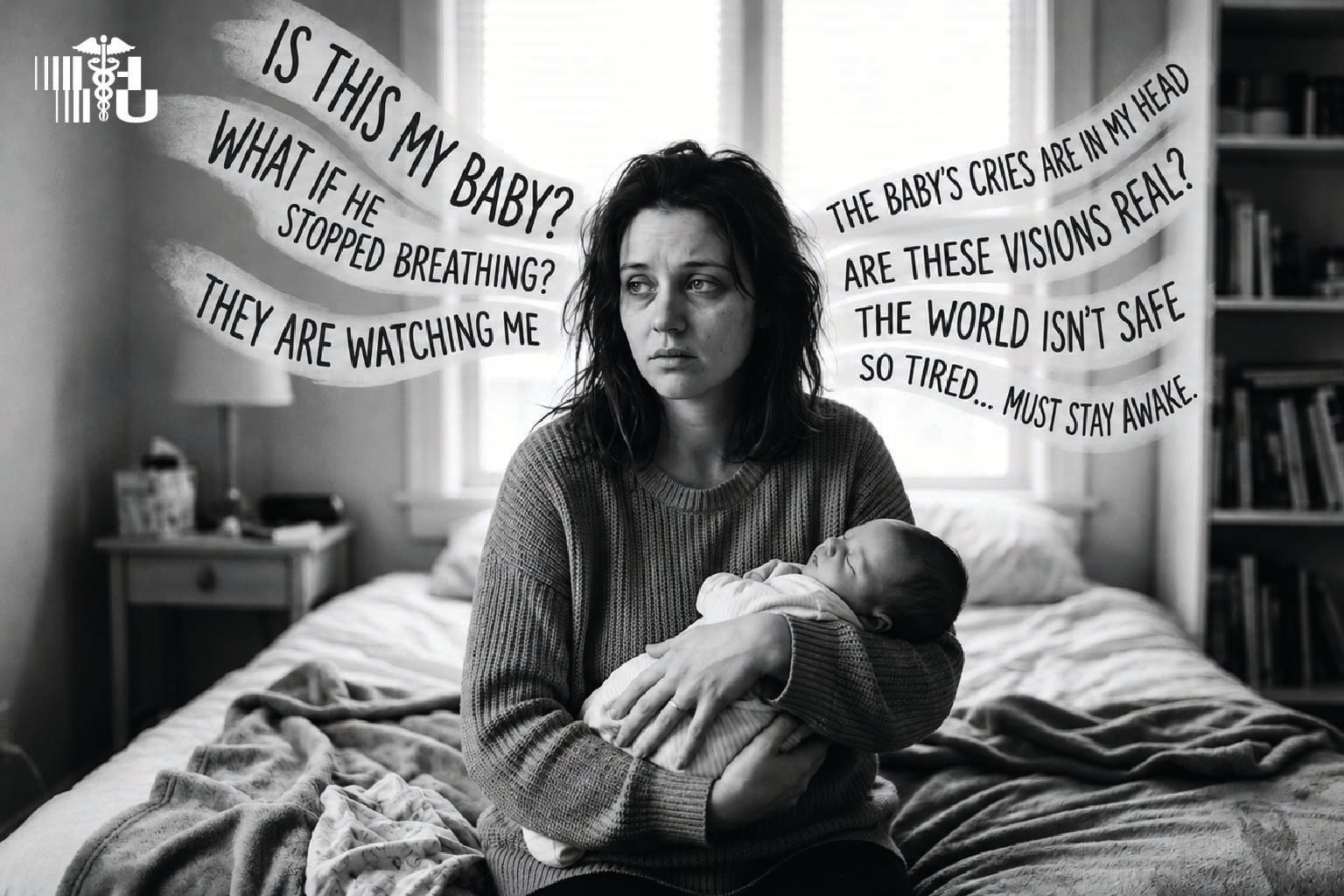
Postpartum mental health conditions can range from temporary “baby blues” to postpartum depression and, in rare cases, postpartum psychosis. While these conditions can share some symptoms, they are not the same, and understanding the differences between postpartum depression vs psychosis can help families recognize when a new mother needs additional support or immediate medical attention.
Postpartum psychosis is especially important to recognize because symptoms can develop rapidly and represent a psychiatric emergency. Knowing the warning signs and seeking care early can make a critical difference.
The Spectrum Nobody Warns You About
Most people have heard of the “baby blues,” the tearfulness and mood swings that hit roughly 80% of new mothers in the first two weeks after birth. Fewer people understand that baby blues sit at one end of a much wider spectrum and that the far end of that spectrum is a genuine medical emergency.
Baby blues usually fade on their own within two weeks. No treatment needed, just support and rest.
Postpartum anxiety and postpartum OCD often travel alongside depression. Racing thoughts, constant worry about the baby’s safety, or repetitive intrusive images are common and treatable.
Postpartum psychosis sits at the far end of that spectrum, affecting roughly 1 to 2 out of every 1,000 births. It’s not simply a more intense version of depression. It’s a break from reality, and it typically comes on fast, often within the first two weeks postpartum.
Harmony United Psychiatric Care is a premier mental health clinic serving communities across Florida.
Find a provider near you
What is Postpartum Depression?
Postpartum depression (PPD) is a mental health condition that lingers past the first two weeks after birth and doesn’t resolve with rest the way baby blues does. It affects somewhere around 1 in 7 new mothers, one of the common complications of childbirth.
Postpartum Depression Symptoms
Common postpartum depression symptoms include:
- Persistent sadness or a low mood that doesn’t lift
- Exhaustion that sleep doesn’t fix
- Guilt or feelings of being incapable as a parent
- Irritability or a short fuse
- Trouble bonding with the baby
- Sometimes intrusive, frightening thoughts
Postpartum Depression Treatment
Postpartum depression treatment usually includes therapy, medication, or a combination of both. Talk therapy helps mothers work through the emotional weight of the diagnosis, while medication management may also be recommended to help manage symptoms, depending on their severity, medical history, and individual needs. Support groups can also help, since connecting with other parents going through the same thing reduces the isolation that often makes PPD feel heavier than it needs to.
What is Postpartum Psychosis?
Postpartum psychosis (PPP) is one of the rarest and most severe postpartum conditions, affecting roughly 1 to 2 out of every 1,000 births. Clinically speaking, it’s a psychiatric emergency, not an extension of ordinary postpartum exhaustion or sadness.
Postpartum Psychosis Symptoms
This is where much of the public understanding falls short. PPP isn’t just “being really overwhelmed.” Postpartum psychosis symptoms:
- Hallucinations – Some mothers hear voices, see things that aren’t there, or feel sensations with no physical cause. It’s disorienting for her and often frightening for the people around her to witness.
- Delusions – Fixed beliefs take hold that don’t line up with reality, like fearing the baby is in danger from someone who isn’t a threat, or believing something is deeply wrong when nothing is. Trying to reason her out of it usually doesn’t work.
- Mania – She might talk fast, jump between ideas, or seem wired in a way that doesn’t match a new parent’s exhaustion. Normal social filters can slip, too, leading to behavior that feels out of character.
- A low mood – This can look like classic depression: pulling away from people, crying easily, running on empty, skipping meals, or lying awake even when the baby’s finally asleep. Agitation and anxiety often ride along with it.
- Mixed or rapidly shifting moods – Some women swing between the high energy of mania and the flatness of depression within the same day, sometimes within the same hour, which makes the condition harder for the family to read.
- Severe confusion – Basic things start to feel foggy or disjointed. She might lose track of time, struggle to follow a conversation, or seem unlike herself in a way that’s hard to put into words but obvious to anyone who knows her.
What Causes Postpartum Psychosis?
Certain factors raise the risk of developing postpartum psychosis, including:
- Already been diagnosed with bipolar or psychotic disorders.
- A family history of postpartum psychosis raises the risk even if she’s never had a mental health issue herself.
- A previous episode of postpartum psychosis after an earlier pregnancy.
Postpartum Psychosis Treatment
Postpartum psychosis treatment starts with a rapid psychiatric evaluation, since this is a condition that needs medical attention right away rather than a wait-and-see approach. Mood stabilizers or antipsychotic medication are usually the first line of care, and a short hospital stay is common in the early days to keep both mother and baby safe while symptoms come under control.
Therapy plays a real role in recovery. Cognitive behavioral therapy (CBT) can help her process the fear and disorientation that often follow a psychotic episode, while dialectical behavior therapy (DBT) is sometimes used when mood regulation and emotional intensity remain a challenge after the acute crisis has passed.
Family therapy is also worth considering, since psychosis affects everyone in the household, not just the mother. With the right combination of medication and therapy, most women recover fully and go on to bond with their babies without lasting complications.

Postpartum Depression vs. Postpartum Psychosis: Know the Difference
| Key Differences | Postpartum Depression (PPD) | Postpartum Psychosis (PPP) |
| Onset | Usually, within the first few weeks, sometimes up to a year after birth | Suddenly, typically within the first 2 weeks postpartum |
| Duration | Weeks to months if left untreated | Requires immediate treatment; doesn’t resolve on its own |
| Key symptoms | Persistent sadness, exhaustion that sleep doesn’t fix, guilt, irritability, trouble bonding with the baby, and sometimes intrusive thoughts | Delusions, hallucinations, severe confusion, disconnection from reality, rapid mood swings, extreme insomnia |
| Urgency | Needs treatment (therapy and/or medication), but an emergency if there is risk of self-harm, harm to the baby, or an immediate safety concern | A psychiatric emergency requires immediate evaluation & treatment |
| Treatment | Therapy, medication, or a combination of both, managed on an outpatient basis | Mood stabilizers or antipsychotics, rapid psychiatric evaluation, and often a short hospitalization |
How Long Do Postpartum Depression and Psychosis Last?
Postpartum depression can last for weeks or sometimes months if left untreated. With therapy, medication, or a combination of both, most mothers see real improvement, though the exact timeline varies from person to person.
Postpartum psychosis doesn’t resolve on its own the way baby blues does, so it isn’t something to wait out. It requires immediate psychiatric treatment. With rapid care, many women stabilize and experience significant improvement.
Why the Adults Around a New Mother Need to Know the Signs
Family members, partners, and friends are often the first to notice something is off, long before a mother would say so herself. You don’t need a clinical background to catch it. Some signs worth taking seriously right away:
- A sudden, severe shift in behavior, speech, or personality
- Talk of harming herself or the baby, even if it sounds vague or “not serious”
- Statements that don’t track with reality, or a sense that she’s somewhere else mentally
- Refusing sleep even when the baby is asleep, and rest is possible
- Withdrawing completely from the baby, or the opposite, an unusual fixation or fear around the baby’s safety
- A personal or family history of bipolar disorder, combined with any of the signs above
If you see these signs, this isn’t a “wait and see” situation. Postpartum psychosis is treated as an emergency medical condition, and it calls for immediate evaluation. Call her OB or a psychiatric provider, or go to an emergency room if you believe she or the baby is in immediate danger. You’re not overreacting. You’re doing exactly what the moment calls for.
Myths vs. Facts
Myth: If a mother seems fine most of the time, it can’t be that serious.
Fact: Postpartum psychosis can fluctuate. A mother might seem lucid one hour and be in crisis the next. Calm moments don’t rule out danger.
Myth: Postpartum psychosis means someone is a bad mother.
Fact: It’s a biological event tied to hormonal shifts, sleep deprivation, and often an underlying condition like bipolar disorder. It has nothing to do with how much she loves her baby.
Myth: If it didn’t happen after the first baby, it won’t happen after the second.
Fact: A prior episode of postpartum psychosis raises the risk of it happening again, but it can also show up for the first time in a later pregnancy, especially if there’s a family history of bipolar disorder.
Myth: Talking about intrusive thoughts will make them come true, so it’s safer not to mention them.
Fact: The opposite is true. Naming intrusive thoughts to a doctor is one of the fastest ways to get proper screening and treatment. Silence is what lets symptoms go unnoticed.
Myth: Postpartum depression is just being tired and stressed with a newborn.
Fact: Normal new-parent exhaustion improves with rest. PPD persists even when a mother gets a break, and it comes with feelings of guilt, hopelessness, or detachment that go beyond fatigue.

The Part That Often Gets Lost: This Is Treatable
Postpartum psychosis is frightening precisely because the general public so poorly understands it, but in clinical terms, it responds to treatment. That usually means rapid psychiatric evaluation, medication (often mood stabilizers or antipsychotics), and in many cases a period of hospitalization to keep everyone safe while symptoms stabilize. With the right care, most women recover fully.
Postpartum depression is treatable too and often more manageable than families expect once a mother is connected with the right therapist for postpartum depression or a structured postpartum depression help group alongside medication management.
Greater awareness matters because recognizing symptoms early can help families seek appropriate care before a psychiatric emergency escalates.
Asking for Support isn’t a Failure
If you’re a new parent reading this and something feels wrong, whether it’s persistent sadness, racing thoughts, or something that feels bigger and scarier than either, you don’t have to figure out on your own whether it’s “serious enough” to mention. That’s what a psychiatric evaluation is for.
If you’re a partner, parent, or friend watching someone you love struggle after childbirth, trust what you’re seeing. You don’t need a medical degree to know when something isn’t right.
If you’ve been searching for mental health care near you because something feels off after childbirth, know that reaching out this early is exactly the right move, not an overreaction. Harmony United Psychiatric Care offers support across Florida, including medication management and telepsychiatry for parents who can’t easily get to an in-person appointment in those early, exhausting weeks. Real, lasting relief is possible, and reaching out is the first step toward getting it.
To schedule an appointment, call 800-457-4573 or submit an appointment request.
If you believe a mother or baby is in immediate danger, call 911 or go to the nearest emergency department. For suicidal or mental health crisis support, call or text 988.
Frequently Asked Questions
Postpartum depression is a mood disorder involving persistent sadness, exhaustion, and guilt that usually develops over the first few weeks after birth. Postpartum psychosis is a rare psychiatric emergency involving hallucinations, delusions, or a break from reality, and it tends to come on suddenly within the first two weeks postpartum.
Not typically. The two conditions have different underlying causes, and postpartum psychosis is more closely linked to bipolar disorder or a family history of it than to depression progressing untreated. That said, both can occur close together, so any new or escalating symptoms after birth deserve prompt evaluation.
It usually appears within the first two weeks after delivery, often faster than postpartum depression, which can take weeks or even months to fully surface. The rapid onset is part of what makes it so easy to miss until symptoms are already severe.
Yes. Treatment usually starts with a rapid psychiatric evaluation and may include medication such as mood stabilizers or antipsychotics, along with a short hospital stay in some cases. With the right care, many women see significant improvement. It’s a medical emergency, but it’s one that responds to treatment.
The exact cause isn’t fully understood. Rapid biological and hormonal changes after childbirth may play a role, and risk is substantially higher among people with bipolar disorder, a previous episode of postpartum psychosis, or certain family histories.
No. Unlike baby blues, postpartum psychosis isn’t something to wait out. It requires immediate psychiatric care, and with prompt, appropriate treatment, recovery is possible. Many women experience significant improvement and are able to reconnect with their babies and families.
Reference Links
https://www.nhs.uk/mental-health/conditions/post-partum-psychosis
https://pmc.ncbi.nlm.nih.gov/articles/PMC9838449
Leave a Reply