

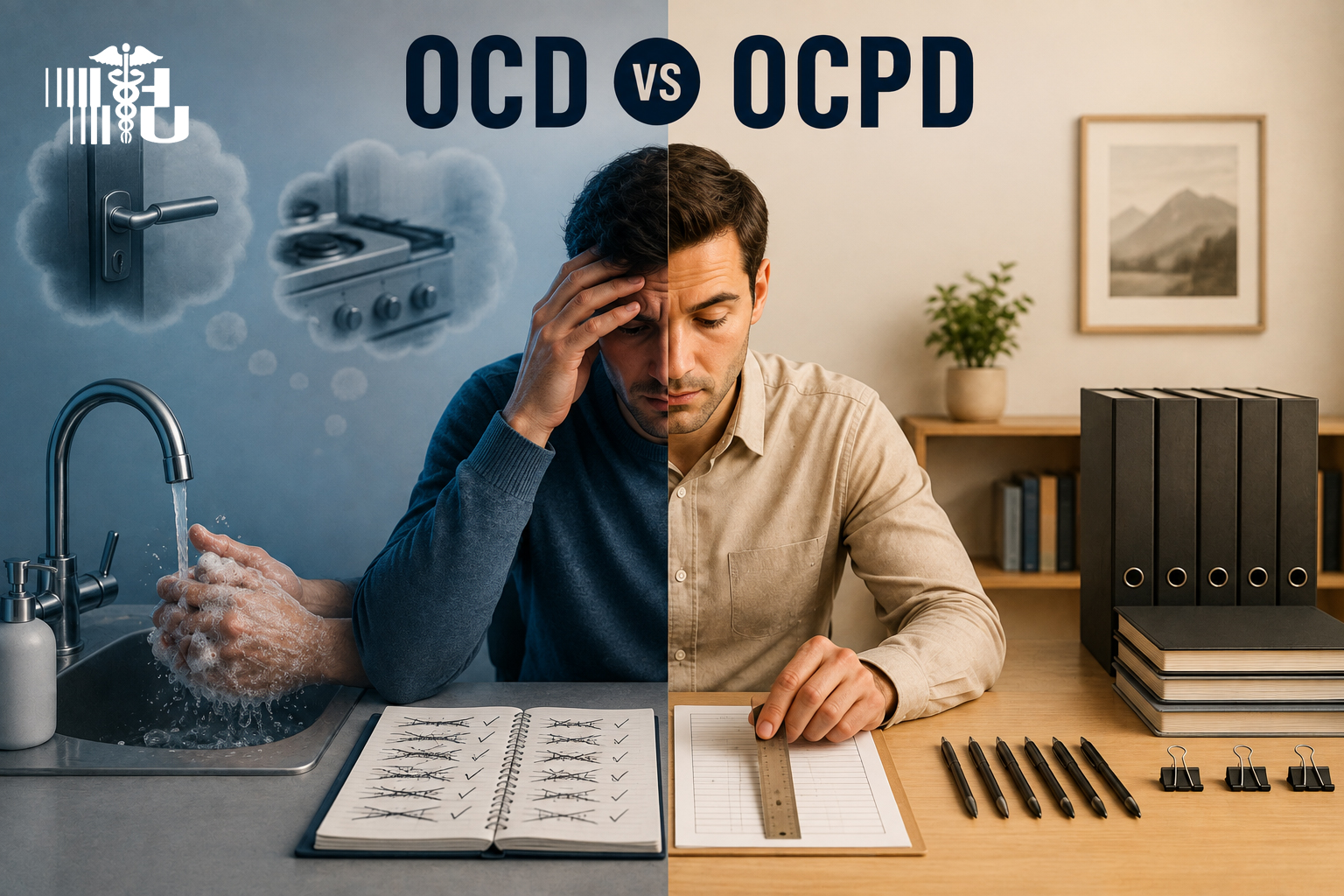
OCD or OCPD can look surprisingly similar, but the reasons behind the behaviors can be very different. Imagine two people sitting in the same waiting room. One repeatedly washes her hands until they’re cracked and sore, terrified that if she stops, someone she loves might get hurt. Across the room, a man rewrites his intake form three times because his handwriting doesn’t line up perfectly inside the boxes. He isn’t anxious about it, just mildly annoyed that the form is “too small to write in properly” and plans to mention it to the receptionist. Although their behaviors may look similar, they’re driven by very different reasons. Only one of them has obsessive-compulsive disorder (OCD). That’s why looking beyond the behavior itself is so important. Understanding what’s motivating those actions helps mental health professionals choose the most effective treatment.
Although Obsessive-Compulsive Disorder (OCD) and Obsessive-Compulsive Personality Disorder (OCPD) share similar names and may seem alike at first glance, they are distinct mental health conditions with different underlying causes, symptom patterns, and treatment approaches. OCD is a mental health condition within the obsessive-compulsive and related disorders category, built on unwanted intrusive thoughts and the compulsions people use to quiet them. OCPD is a personality disorder rooted in rigid perfectionism and control. Mixing them up doesn’t just cause confusion; it can send someone into the wrong treatment entirely, which is why an accurate OCD diagnosis matters as much as the therapy that follows. At Harmony United Psychiatric Care near you, that careful evaluation is a key part of every comprehensive psychiatric assessment.
Harmony United Psychiatric Care is a premier mental health clinic serving communities across Florida.
Find a provider near you
What is the Difference Between OCD and OCPD?
Think of OCD as a smoke alarm that won’t stop blaring even when there’s no fire. The person knows the alarm is malfunctioning; the thoughts feel intrusive, unwanted, and distressing, but the compulsion (checking, washing, counting) is the only thing that quiets it, even briefly. OCPD works more like a thermostat set permanently to “perfect”. There’s no false alarm and no distress about the rigidity itself; the person genuinely believes their way is the right way, and it’s everyone else who has the problem.
| Feature | OCD (Obsessive-Compulsive Disorder) | OCPD (Obsessive-Compulsive Personality Disorder) |
| Core nature | Anxiety disorder | Personality disorder |
| Relationship to symptoms | Ego-dystonic: Alleviating anxiety caused by intrusive obsessions. | Ego-syntonic: Maintaining complete personal control and perfection. |
| Insight | A person usually knows the thoughts and behaviors are irrational. | A person usually doesn’t see a problem with their own rigidity. |
| What drives the behavior | Intrusive, unwanted thoughts that trigger anxiety. | Persistent need for order, control, and doing things the “right” way. |
| Function of the behavior | Compulsions temporarily relieve the distress caused by obsessions. | Rigid behavior isn’t relieving anything; it’s simply how the person operates. |
| Example | Checks the stove twelve times, hating every second and wishing they could stop. | Reorganizes a coworker’s spreadsheet without being asked, certain that the original was wrong. |
| When both appear together | Yes. A person can have both OCD and OCPD, but they are separate conditions that require their own evaluation and treatment. | Yes. OCPD and OCD can occur together, though one does not cause the other. |
Why the Distinction Actually Changes Outcomes
Research shows roughly 1 in 40 adults in the U.S. lives with OCD, while OCPD shows up in an estimated 3 to 8 percent of the population, making it one of the more common personality disorders, if one of the least talked about. The similarity in their names can sometimes lead to confusion, making a careful evaluation essential for an accurate diagnosis: research has found that a meaningful share of people initially flagged for “OCD-like” perfectionism actually meet criteria for OCPD instead, or for both.
The mechanism behind why this matters is straightforward. OCD responds best to Exposure and Response Prevention (ERP), a form of CBT that gradually exposes someone to their feared trigger while blocking the compulsive response, retraining the brain to tolerate the anxiety without acting on it. OCPD, by contrast, rarely responds to ERP at all, because there’s no anxiety loop to interrupt; the rigidity feels correct, not distressing. It generally needs longer-term psychotherapy focused on flexibility, insight, and tolerating imperfection, sometimes alongside medication for co-occurring anxiety disorders.’
Precision Diagnosis vs. Guesswork: Why It Matters
- Right therapy, faster relief: ERP aimed at someone with pure OCPD can stall out fast because there’s no compulsive loop to disrupt.
- Less wasted time: A clear diagnosis means starting the correct treatment path instead of cycling through approaches that were never built for the condition.
- Medication that actually fits: OCD often responds to SSRIs at higher doses than typical anxiety treatment; OCPD medication decisions usually hinge on co-occurring conditions instead.
- Validates the patient’s experience: Someone with OCD stops feeling like their distress is being dismissed as “just being a perfectionist.”
- Catches the overlap cases: Patients with traits of both get a treatment plan that actually addresses each piece, rather than one diagnosis masking the other.
Where the Challenges Still Are
None of this is simple in practice. OCPD in particular is underdiagnosed, partly because people who have it rarely think anything is wrong; they show up for couples counseling or workplace stress, not personality assessment. Insurance coverage for the longer-term therapy OCPD often requires can be harder to secure than coverage for a defined ERP protocol. And clinicians without specific training in personality disorders can still mislabel OCPD as “just OCD with better insight,” which sends patients down the wrong treatment path.
Even so, awareness is catching up. Diagnostic tools are getting sharper at separating the two, and more training programs are teaching clinicians to ask about the distress behind a behavior, not just the behavior itself, which is often the fastest way to tell these two apart.
Getting the diagnosis right isn’t a technicality. It’s the difference between a treatment plan that fits and months spent working against the wrong problem. Mental health help is always available near you.
How Harmony United Psychiatric Care Treats Each Condition
If you or someone you love is struggling with obsessive thoughts, rigid perfectionism, or symptoms that don’t seem to fit neatly into one box, Harmony United Psychiatric Care throughout Florida offers comprehensive support. For us, OCD treatment usually means psychotherapy built around ERP, often paired with an SSRI through medication management, starting with a psychiatric evaluation to confirm it’s actually OCD and not OCPD. If therapy and medication haven’t been enough, TMS therapy is also an option.
OCPD responds better to longer-term psychotherapy focused on flexibility and insight, sometimes alongside couples or family sessions when the rigidity is straining relationships. Neuropsychological testing can help when cognitive symptoms make either diagnosis unclear.
Call (800) 457-4573 or schedule an online appointment to get the right diagnosis and the right treatment plan.
Frequently Asked Questions
The biggest difference is what drives your behavior. With OCD, unwanted intrusive thoughts create anxiety, and repetitive behaviors are used to temporarily relieve that distress. With OCPD, the focus is on order, perfection, and control, and those behaviors usually feel appropriate rather than upsetting. Because the two conditions can sometimes overlap, evaluation is the best way for making an accurate diagnosis.
Yes. Although OCD and OCPD are separate mental health conditions, it’s possible to have both at the same time. When that happens, each condition needs to be identified and treated individually, since they respond to different therapeutic approaches.
OCD is characterized by intrusive, unwanted thoughts (obsessions) and repetitive behaviors (compulsions) performed to reduce anxiety. OCPD is a personality disorder marked by rigid perfectionism, a strong need for control, and high personal standards that generally feel consistent with the person’s beliefs. While the behaviors may sometimes look similar, the reasons behind them are very different.
Sometimes, but not always. Perfectionism can appear in both OCD and OCPD, though it serves different purposes. In OCD, perfectionism is often driven by fear or anxiety about making a mistake. In OCPD, it reflects a long-standing preference for order, control, and doing things the “right” way. A mental health provider can help determine what’s driving those patterns.
OCD is diagnosed through a comprehensive psychiatric evaluation that looks at your symptoms, medical history, and how obsessive thoughts and compulsive behaviors affect your daily life. The goal is not only to identify OCD but also to rule out other conditions with similar features, including OCPD.
The most effective treatment for OCD often includes Exposure and Response Prevention (ERP), a specialized form of Cognitive Behavioral Therapy (CBT). Many people also benefit from medication, particularly selective serotonin reuptake inhibitors (SSRIs). Your treatment plan should be tailored to your symptoms and individual needs.
OCPD is typically treated with psychotherapy that focuses on increasing flexibility, improving self-awareness, and building healthier ways of thinking and relating to others. If anxiety or depression occurs alongside OCPD, medication may also be recommended as part of a personalized treatment plan.
An accurate diagnosis helps you receive the treatment that’s most likely to help. For example, ERP is considered highly effective for OCD but may not address the core challenges of OCPD. Understanding which condition you’re experiencing can save time, reduce frustration, and lead to more meaningful, lasting progress.
If obsessive thoughts, compulsive behaviors, or rigid perfectionism are interfering with your relationships, work, school, or daily life, it’s a good idea to seek a professional evaluation. Getting support early can help you better understand what’s happening and connect you with treatment that’s right for your situation.
Reference Links
https://www.nimh.nih.gov/health/statistics/obsessive-compulsive-disorder-ocd
Leave a Reply