

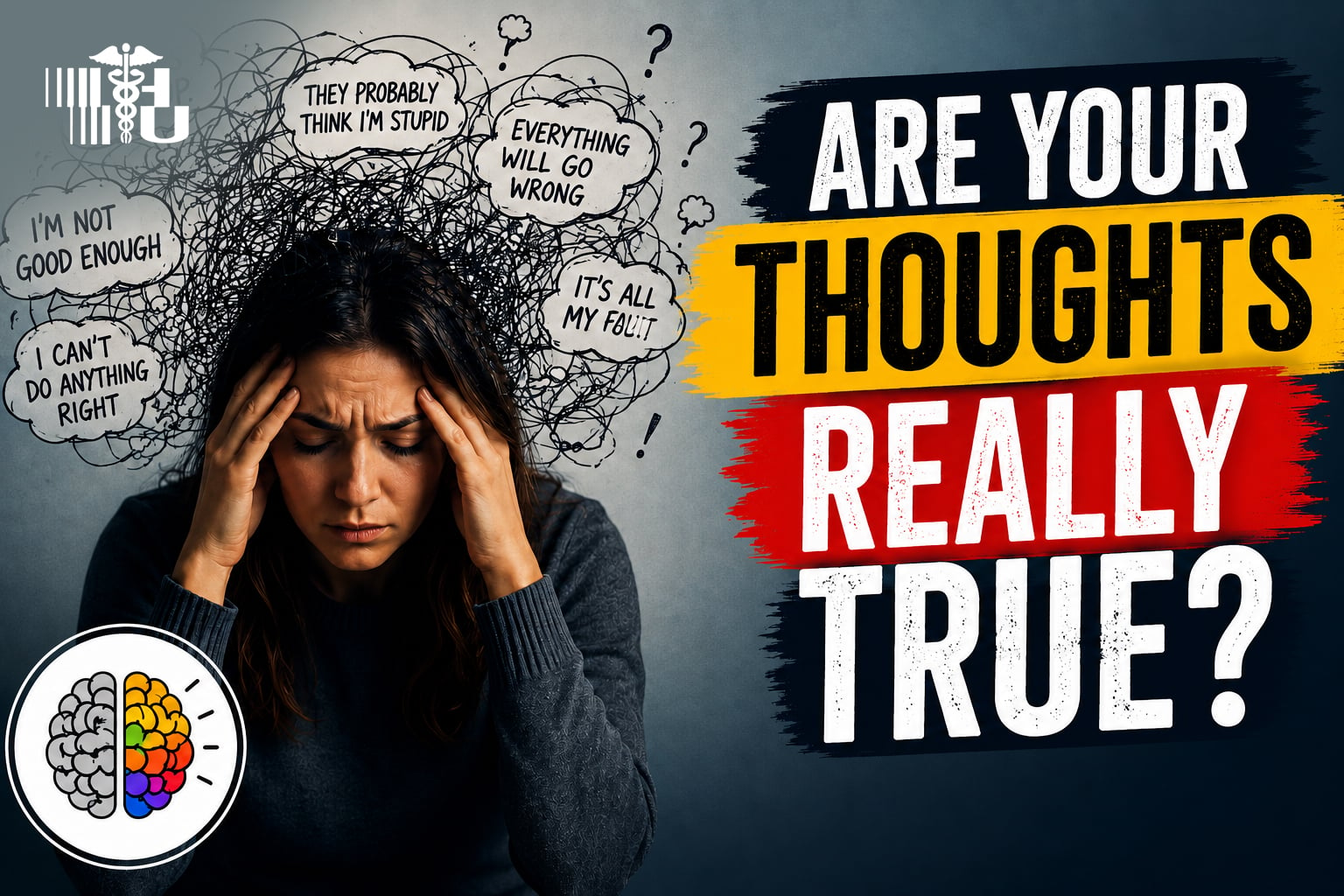
Have you ever caught yourself thinking, “I always mess things up,” after one small mistake, or assumed the worst outcome before anything had even happened? These aren’t just bad moods or random pessimism. They’re often signs of cognitive distortions, negative thinking patterns that can twist reality and feel true, even though they aren’t based on facts. You can help change these thinking patterns to promote your mental well-being.
What Are Cognitive Distortions?
Cognitive distortions are automatic, inaccurate, or exaggerated patterns of thinking that can influence how we interpret ourselves, other people, and situations.
They’re a core concept in Cognitive Behavioral Therapy (CBT), a widely used approach that helps people recognize and reframe distorted thinking. The tricky part is that these thoughts often feel completely rational in the moment, which is exactly what makes them so powerful and so hard to catch on your own.
Cognitive distortions can develop for many reasons. Stress, difficult experiences, learned beliefs, and longstanding patterns of interpreting situations may all influence how we think.
In other words, experiencing stress could cause you to adapt your thinking in useful ways for immediate survival. But these thoughts often aren’t rational or healthy in the long term.
Harmony United Psychiatric Care is a premier mental health clinic serving communities across Florida.
Find a provider near you
Common Types of Cognitive Distortions
Understanding the different types of cognitive distortions can make them easier to spot in your own thinking and help you to work on your mental well-being. Some of the most common include:
Polarized thinking
It’s also called “all-or-nothing” or “black-and-white thinking.” This distortion occurs when people habitually think in extremes without considering all the possible facts in a given situation.
When you’re convinced that you’re either destined for success or doomed to failure, that the people in your life are either saints or devils, you’re probably engaging in polarized thinking.
This kind of distortion is unrealistic and often unhelpful because reality often exists between the two extremes.
Overgeneralization
When people overgeneralize, they reach a conclusion about one event and then incorrectly apply that conclusion across the board. In other words, you might assume that one negative event means every subsequent event thereafter will be negative too.
For example, you score low on one math test and conclude that you’re hopeless at math in general. You may have a negative experience in one relationship and then believe that you just aren’t good at relationships.
Overgeneralization has been associated with post-traumatic stress disorder (PTSD) and other anxiety disorders.
Catastrophizing
This distorted thinking leads people to assume the worst when faced with the unknown, despite the lack of evidence supporting such predictions. When people catastrophize, ordinary worries can quickly escalate.
For instance, an expected check doesn’t arrive in the mail. A person who catastrophizes may begin to fear it will never arrive and that, as a consequence, it won’t be possible to pay rent, and the whole family will be evicted.
It’s easy to dismiss catastrophizing as an overreaction. Still, people who have developed this cognitive distortion may have experienced repeated adverse events like chronic pain or childhood trauma so often that they fear the worst in many situations.
Personalization
One of the most common errors in thinking is taking things personally when they’re not connected to or caused by you at all.
You may be engaging in personalization when you blame yourself for circumstances that aren’t your fault or are beyond your control.
Another example is when you incorrectly assume that you’ve been intentionally excluded or targeted.
Personalization has been associated with heightened anxiety and depression.
Mind Reading
When people assume they know what others are thinking, they’re resorting to mind-reading. With this cognitive distortion, you may also assume that others are thinking negative thoughts about you.
It can be difficult to distinguish between mind reading and empathy, the ability to perceive and understand what others may be feeling.
To tell the difference between the two, it might be helpful to consider all the evidence, not just the evidence that confirms your suspicions or beliefs.
A study found that mind-reading is more common among children than adolescents or adults and is associated with anxiety.
Mental Filtering
This distorted thought pattern involves the tendency to ignore positives and focus exclusively on negatives. This is known as mental filtering.
Interpreting circumstances using a negative mental filter is inaccurate and can also worsen anxiety and depression symptoms. It has been found that having a negative perspective of yourself and your future can lead to feelings of hopelessness.
Discounting the positive
Like mental filters, discounting the positive involves a negative bias in thinking. As the name suggests, discounting the positive essentially means dismissing or ignoring positive events.
People who tend to discount the positive don’t ignore or overlook something positive. Instead, they explain it away as a fluke or sheer luck.
Instead of acknowledging that a good outcome results from skill, smart choices, or determination, they assume that good results must be an accident or anomaly.
When people believe they have no control over their circumstances, it can reduce motivation and cultivate a sense of “learned helplessness.”
“Should” statements
When people think in terms of what “should” and “ought” to be done or said, it’s cognitive distortion at work.
It’s rarely helpful to chastise yourself for what you “should” be able to do in a given situation. “Should” and “ought” statements are mostly used by the thinker to take on a negative view of their life.
These types of thoughts are rooted in internalized family or cultural expectations that might not be appropriate for an individual.
Such thoughts can diminish your self-esteem and raise anxiety levels.
Emotional reasoning
Emotional reasoning refers to the false belief that your emotions are the truth and that the way you feel about a situation is a reliable indicator of reality.
Emotional reasoning happens when we assume that because something feels true, it must be true. For example, “I feel like I’m going to fail, so I probably will.” Emotions are important and valid, but they don’t always accurately reflect a situation.

Labeling
Labeling is a cognitive distortion in which people classify themselves in a negative way following an undesirable event. For example, they might reduce themselves or other people to a single, usually negative characteristic, such as a “failure.”
When people label, they define themselves and others based on a single event or behavior. Labeling can cause people to berate themselves. It can also cause the thinker to misunderstand or underestimate others.
This misperception can cause problems between people.
How to Challenge Cognitive Distortions
Recognizing distorted thinking is the first step, but learning how to challenge it is where real change happens. A few strategies that can help:
- Name the pattern: Simply identifying which pattern you’re falling into (catastrophizing, mind-reading, etc.) can create distance from the thought. If you are failing to do so, take the help of a mental health provider near you.
- Look at the evidence: What actual proof supports this thought? What evidence contradicts it? Try to refrain from that situation. Write down the possible solution to come out of that situation.
- Consider another explanation: What would you tell a friend who had this exact thought? Try to find the best solution in the exact situation for damage control.
- Talk to yourself as you would a friend: Consider what you would say to someone you care about in the same situation.
- Consider CBT: While several therapy approaches exist, such as Acceptance and Commitment Therapy (ACT) or Dialectical Behavior Therapy (DBT), psychiatrists often point to Cognitive Behavioral Therapy (CBT) as especially helpful because it teaches people how to change unhelpful thoughts and behaviors in order to feel better.
When Distorted Thinking Becomes Something More
Occasional negative thoughts are part of being human. But when cognitive distortions become frequent, persistent, or start affecting your relationships, work, or daily functioning, they may be connected to something deeper, like anxiety or depression. That’s often a sign it’s time to talk to someone who can help you understand what’s really going on beneath the surface.
If you’ve noticed these thought patterns showing up again and again and you’re not sure how to break the cycle, know that real, lasting relief is absolutely possible. Harmony United Psychiatric Care offers compassionate, personalized support across Florida to help you understand and reframe distorted thinking. Their team of trained professionals is the best in therapies like ACT, CBT, DBT, medication management, neuropsychological testing, and also telepsychiatry for those who prefer care from home, so you don’t have to carry these thought patterns by yourself.
To schedule an appointment, call 800-457-4573 or submit an appointment request and take that first gentle step toward caring for your own mental health, too.
The bottom line
Cognitive distortions are habitual ways of thinking that are often inaccurate and negatively biased.
Cognitive distortions usually develop over time in response to adverse events. If you’re ready to tackle cognitive distortions, you may want to try some of the methods found in CBT. This type of therapy has been successful in helping people identify cognitive distortions and retrain themselves to look at the world in a clearer, more rational way.
Frequently Asked Questions
Cognitive distortions are irrational or exaggerated thought patterns that convince you of something inaccurate, usually something negative about yourself, other people, or a situation. They feel true in the moment, even though they’re not based on fact.
The most common types include polarized all-or-nothing thinking, overgeneralization, catastrophizing, personalization, mind reading, mental filtering, discounting the positive, “should” statements, emotional reasoning, and labeling.
Cognitive distortions typically develop as a coping response to stress or adverse life events. The brain adapts its thinking patterns to handle immediate difficulty, but over time, those patterns can become inaccurate and unhelpful rather than protective.
Common signs include jumping to worst-case conclusions, seeing situations in extremes, assuming you know what others are thinking, or dismissing positive outcomes as luck rather than your own efforts.
Yes. Research links several cognitive distortions, including personalization, mental filtering, and mind reading, to increased anxiety and depression. Left unaddressed, these thinking patterns can also contribute to feelings of hopelessness.
Yes. CBT is one of the most researched and widely used approaches for identifying and reframing cognitive distortions. Providers offering CBT and other therapy options can help you learn to recognize distorted thoughts and replace them with more balanced thinking.
If distorted thinking becomes frequent, persistent, or starts affecting your relationships, work, or daily life, it may be connected to something deeper, like anxiety or depression. A psychiatric provider at Harmony United Psychiatric Care can help you understand what’s underneath the pattern and guide you toward treatment that fits your needs.
Reference Links
https://www.ncbi.nlm.nih.gov/pmc/articles/PMC4991044
https://www.ncbi.nlm.nih.gov/pmc/articles/PMC5141652
https://pubmed.ncbi.nlm.nih.gov/26202072
Leave a Reply